Contents
- Index
Spectral Contamination
Spectral contamination refers to a measurement of intermodulation distortion induced by numerous simultaneous tones ("multitone"), typically appearing as an increase in the noise floor well below the levels of the tones, shown in Spectrum Analyzer curves. The tones used in OmniMIc software are log-frequency (constant multiple) spaced to minimize the likelihood of harmonic and intermodulation distortion products falling at the frequencies of applied tones.
The software shows the spectrum of the output in two overlapping traces: in BLUE, containing the overall output from the measured audio system. And in RED, which has energy in bandwidths near the applied tones removed and the calculated noise floor displayed numerically. The numerical values with and without the tones being applied can be compared for an indication of how much the noise floor is being raised or what it is being raised to. The SPL meter will show the overall SPL level, including tone energy, being sensed. The noise level increase will be more marked as volume levels are increased, but be careful of increasing volume too much to avoid damage to equipment or your hearing!
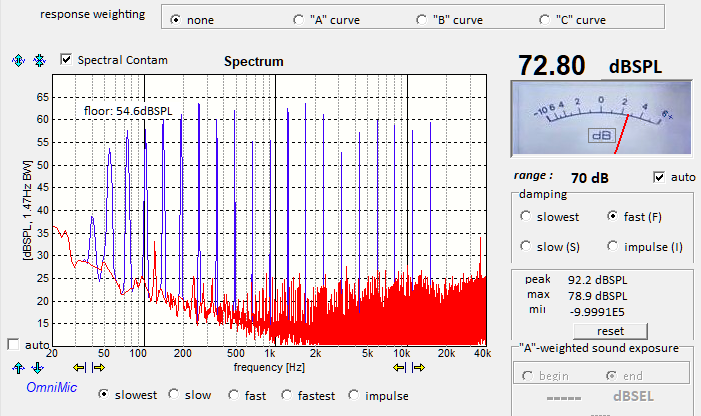
There will be some variation in noise floor calculation because content in bands around the tones must be excluded and estimated from the nearby non-excluded regions. Changes of only a dB or so are probably not meaningful. The A, B, or C weighting curves can be applied to the microphone pickup to effectively shape or limit the frequency range being analyzed.
The tones for direct output or for WAV file generation can be configured with a configuration form which appears when Spectral Contamination is selected. The tones can be adjusted with a slope matching a white (flat) or pink (-3dB/octave) spectrum. Too closely placed tones at low frequencies should be avoided, as the exclusion bands are about 12.5Hz wide and will start to cover most or all of the frequency space between the tones.
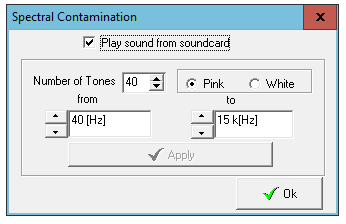
The test can be used to indicate when a system is having trouble reproducing the multitone, however it is limited in many cases to the level of the existing noise floor in the room. For example, if the noise floor were at -55dBSPL, then induced distortion levels near or below that cannot be clearly detected. Acoustic noise sources in the area should be reduced if possible, and the setup should be arranged for maximum dynamic range.
A statement of a measurement result could be
"With [specified multitone configuration] and a level of [SPL meter] dBSPL at [distance] meters, a noise floor of [..] dBSPL was induced."
This result would only be significant, though, if the background noise was low enough that the test showed a significant increase in the noise floor when the system was driven.